
How LinkedIn Silently Killed My Reach, Denied It Three Times, and Only Fixed It When I Mentioned GDPR
How LinkedIn Silently Killed My Reach, Denied It Three Times, and Only Fixed It When I Mentioned GDPR
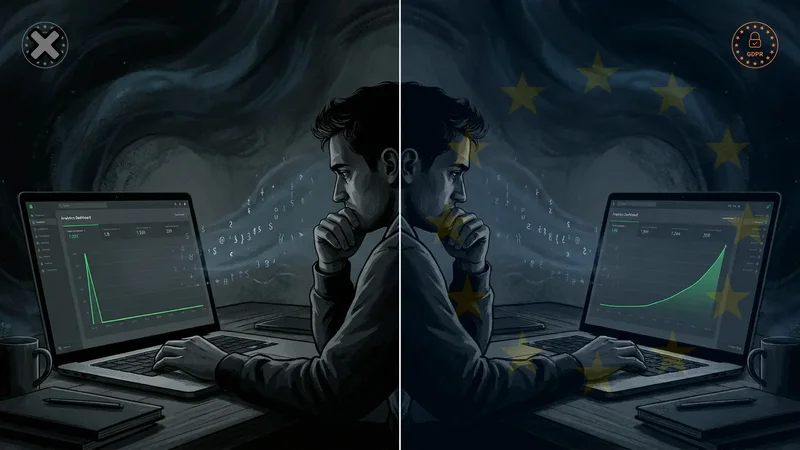
I started posting on LinkedIn about a month ago. First post did almost 10k impressions. Every single post after that? Under 50. For three weeks straight.
This is the story of how a single post with two external links apparently got my account flagged, how LinkedIn support copy-pasted their way through three rounds of “nothing is wrong,” and how a formal GDPR data access request was the only thing that actually moved the needle.

If you’re a developer using LinkedIn to build an audience and your reach suddenly flatlined, this might save you a few weeks of talking to walls.
The Setup
I’m a senior full-stack engineer with 10+ years of experience. I teach programming. I build things. I decided to start sharing opinions on LinkedIn because apparently that’s what you do in 2026.
First post was an opinionated take on developer skills in the AI era. It did well. ~10k impressions, 30+ reactions, 30 comments. Not viral, but solid for a brand new account with barely any connections.
Then I made a mistake.
The Mistake
I published a post containing two external links. Nothing spammy. Just links to relevant content. I deleted the post after a week because it wasn’t performing.
But from the moment I posted those links, everything, slowly but inevitably, died.
Every post I published after that got fewer than 200 impressions. Most got fewer than 50. It didn’t matter what I wrote, when I posted, or what format I used. I was basically invisible.
For context: during this period, I also activated LinkedIn’s free Premium trial. The timing made me suspect Premium was involved. It probably wasn’t. But it was a convenient red herring that cost me a week of debugging the wrong problem.
What I Tried (And What Didn’t Work)
Everything the internet tells you to do:
Paused all activity for 48-72 hours, multiple times -> no effect
Switched to comment-only engagement for days -> no effect
Changed topics, formats, posting times -> no effect
Posted twice a week instead of daily -> no effect
Posted daily instead of twice a week -> you know what? No, sorry, no effect
My comments on other people’s posts were visible. People replied to and liked them. I could log in, send messages, connect to other accounts, do everything a normal account does. But my posts reached nobody, silently.
This wasn’t an algorithm preference issue. This was a 99.5% drop that persisted for three weeks across all content types. That’s not “your content isn’t resonating.” That’s a flag on your account. Luckily, me and my AI agents team are well trained at recognizing this kind of pattern, so I had enough motivation to do what nobody wants to do on social media: open the scary support ticket page.
Round 1: Support Discovers I Exist
I opened a support ticket.
No, wait. How do you even open a support ticket? This kind of UX should be definitely illegal. You basically have to fight an LLM trained to not lead you to the ticket page at all costs. But hey! I’m a nomad warrior, I can win this round.
Once you finally reach the form, you have to pick some random tag for your ticket. Why random? Because none of the choices are relevant to cases that should actually reach support, like mine. So I tried to stay as close as possible to my user flagged issue, and then I went deep in my description.
Claude Opus 4.6, extended thinking. It knows the actual situation (I’m debating with it daily to define my distribution path), so I used it to generate a clear, data-driven, specific issue description:
Hi, my post impressions dropped from 9,479 (first post, 3 weeks ago) to under 50 per post, and haven’t recovered. The drop happened right after I published and deleted a post with 2 external links. Since then, no post has exceeded 200 impressions. I’ve tried pausing activity multiple times — nothing changed. I don’t use automation tools, I haven’t received any policy warnings, and my comments on others’ posts are visible and get replies. The issue seems to be limited to my post distribution only. Could you check if there are any flags or restrictions affecting my account’s post visibility? Thank you, bla bla…
First response: a generic template about duplicate accounts and identity verification. Completely unrelated to my question.
I replied clarifying the actual issue.
Second response: “forwarded to another group for review.” Progress. Maybe.
Third response: a full copy-paste explanation of how LinkedIn’s algorithm works. “Member expectations,” “relevance algorithm,” “viewer tolerance,” “freshness of content.” They said they “didn’t find any technical inconsistencies.” I wasn’t happy about this response.
Note what they did NOT say: “your account has no restrictions.” The phrase “no technical inconsistencies” is carefully vague. It doesn’t confirm or deny anything about flags, scores, or distribution limits.
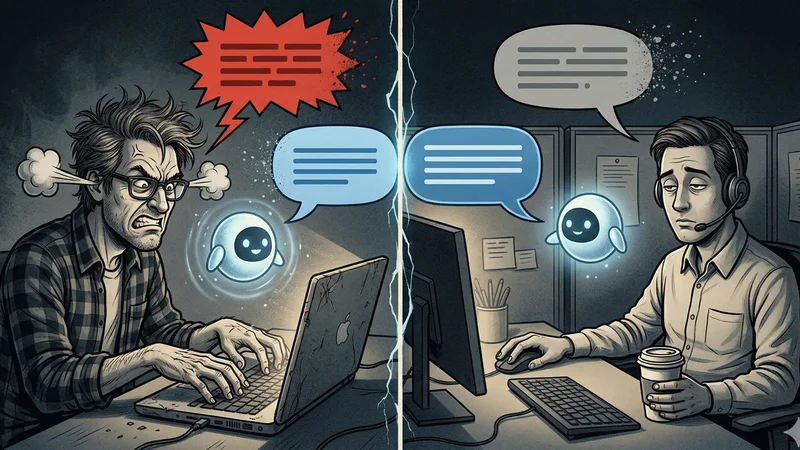
At no point did anyone answer the actual question. The funny part? We were both basically crafting rough replies to each other, mediated by the kindness of each other’s LLM.
Round 2: GDPR Enters the Chat
I’m an EU resident. Under Article 15 of the GDPR, I have the right to access my personal data, including information about automated decision-making and profiling that affects me.
If LinkedIn's systems applied any flag, score, or restriction to my account, that's personal data I'm legally entitled to see
So I added a formal GDPR data access request to the same support thread:
Any flags, restrictions, or classifications applied to my account
Any content moderation actions taken on my posts
Any automated profiling or scoring data affecting my content distribution
Meaningful information about the logic involved in automated decision-making (Article 15)
Cited LinkedIn Ireland as the data controller for EEA users
Noted the 30-day response deadline under Article 12
They ignored it completely. Next reply was another algorithm explainer.
So I restated the GDPR request in formal legal language. Made it impossible to miss. Made it clear that closing the case without addressing a formal data access request would be a separate compliance issue.
The Silence That Spoke Volumes
Up to this point, every support reply came within 30-60 minutes. After the formal GDPR request? 20+ hours of silence. Then a new response with a very interesting sentence buried in yet another template:
“If you experienced any temporary issues previously, they may have been related to normal system checks or short-term technical behavior, which have since been resolved.”
Read that again. “Short-term technical behavior which has since been resolved.”
That’s the closest LinkedIn will ever come to saying “Yes, your account was flagged, and we just unflagged it. We are sorry.”
They also confirmed “no restrictions or limitations” were currently applied. The word “currently” doing a lot of heavy lifting in that sentence.
The Recovery
I posted the next day. First hour: 104 impressions. Second hour: 188. By end of day: 2,000+ impressions on 1,200+ unique members and counting in just 9 hours on a single post. The account skyrocketed from “22nd March: 6 impressions” to “25th March: 2,000+ impressions” (and counting).
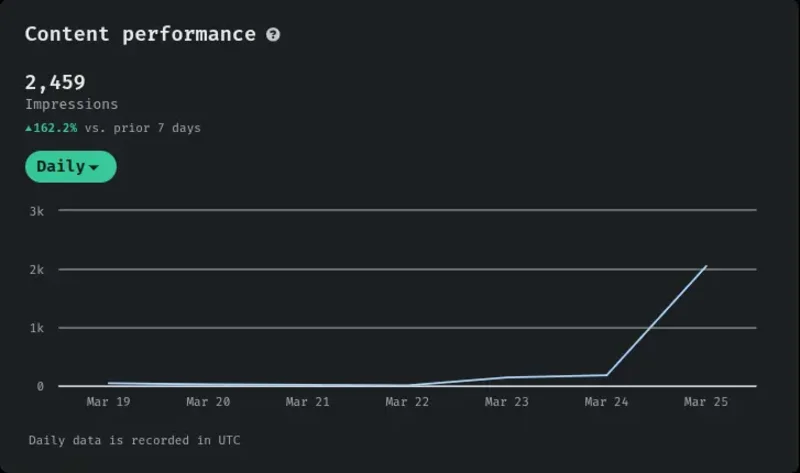
For a recovering account with fewer than 500 connections, these are normal, healthy numbers. Not viral. Just… normal. Which is all I ever asked for.
What I Think Actually Happened
I can’t prove any of this. LinkedIn will never confirm it, and I’m not affiliated with them in any way.
But here’s my working theory based on the evidence:
The post with external links triggered an automated flag. LinkedIn’s system classified the account as potentially spammy
Deleting the post didn’t remove the flag. The signal was already recorded (perhaps it even reinforced it)
The flag suppressed post distribution but not other account features (comments, messages, profile visibility). This is consistent with what multiple sources describe as a content distribution restriction vs. a full shadow ban
Three weeks of normal behavior didn’t clear it automatically
Multiple 48-72 hour pauses didn’t clear it
Support copy-pasted their way through multiple rounds without investigating
A formal GDPR request forced the ticket to someone who could actually look at account-level data
That person found something, cleared it, and the template response called it “short-term technical behavior”
Lessons for Developers on LinkedIn
If your reach suddenly dies Don’t assume it’s your content. If impressions drop 90%+ overnight and stay there across multiple posts of different types, that’s probably not algorithmic preference. That’s a flag.
External links are still risky LinkedIn officially says links don’t cause penalties. Independent research consistently shows 25-60% reach reduction for posts with external links. My experience suggests it can be much worse on new accounts. Avoid links entirely until your account has a stable posting history. The most common techniques to work around this are:
Link in the first comment (considered risky as well by some sources)
Ask people to DM you, or to comment a specific word, in order to start a direct conversation and share the link privately
Use the Premium custom button (paid feature, no free version)
Support will not help you through normal channels I went through three rounds of copy-paste responses. The agents either can’t see account-level flags or aren’t authorized to discuss them. Don’t give up. Responses in the one-hour range are a waste of tokens. Just briefly parse them with AI and craft a reiteration requesting a human review of your account, no matter what they say.
If you’re in the EU, GDPR is your leverage Article 15 gives you the right to access personal data including automated profiling data. Article 22 covers automated decision-making. LinkedIn Ireland is the data controller for EEA users. They have 30 days to respond. If they don’t, you can file a complaint with your national data protection authority. In Italy, that’s the Garante per la protezione dei dati personali. Every EU country has an equivalent.
The magic template to use:
Hi contact name,
Thank you for your reply. I appreciate the additional detail, but I need to point out two issues:
You did not confirm or deny whether my account has any flags, restrictions, trust scores, spam classifications, or content moderation actions applied to it. I’m asking for a direct answer: does my account have any flags or distribution restrictions, yes or no?
More importantly, my previous message included a formal data access request under Article 15 of the GDPR. This was not acknowledged in your response. I will restate it clearly:
FORMAL GDPR DATA ACCESS REQUEST, Article 15, Regulation (EU) 2016/679
I, your name, EU resident (your country), hereby exercise my right of access under Article 15 of the General Data Protection Regulation. I also invoke my rights under Article 22 regarding automated decision-making and profiling.
I request that LinkedIn Ireland Unlimited Company, as the data controller for EEA users, provide me with the following personal data:
a) Any flags, restrictions, classifications, or labels applied to my account or profile b) Any content moderation actions or decisions taken regarding my posts c) Any automated profiling scores or signals associated with my account that affect the distribution or visibility of my content (including but not limited to: trust scores, spam scores, content quality scores, shadow ban status, or distribution throttling indicators) d) Meaningful information about the logic involved in any automated decision-making that significantly affects my content’s reach, as required by Article 15(1)(h)
LinkedIn is required to respond to this request without undue delay and no later than 30 days from receipt (Article 12(3)).
If this support channel is not the appropriate place to process GDPR requests, please direct me to the correct team or data protection officer immediately. Do not close this case until the GDPR request has been properly addressed or redirected.
Thank you, your name
This turns a customer service complaint into a legal obligation. First-tier support agents cannot close a ticket with a copy-paste when a formal data access request is sitting in it.
The Bigger Picture
Here’s what bothers me about this. I’m a senior engineer. I know how to read documentation, cite regulations, write formal requests, and escalate systematically. What happens to the 23-year-old bootcamp graduate who starts posting on LinkedIn, gets silently flagged, sees zero engagement, and concludes “I guess my content just isn’t good enough”?
They quit. They never find out why. LinkedIn never tells them.
The platform that positions itself as the world’s professional network has no meaningful way for users to understand why their content isn’t being distributed. Support agents either can’t access distribution data or aren’t authorized to share it. The only reason I got a result is because EU privacy law gave me a legal crowbar.
That’s not a platform acting in good faith. That’s a system designed to be opaque, one that avoids the effort required to actually support the prediction algorithms it uses to distribute content.
If you’ve experienced something similar, I’d genuinely like to hear about it. Especially if you’ve filed a GDPR or equivalent data access request with LinkedIn and received a substantive response. I’m collecting these stories because I think there’s a pattern worth documenting.
You can reach me at giovanni@wows.dev