
Best Python Code Graders for CS Teachers in 2026
The Best Python Code Graders for Teaching in 2026 (Compared)
CS educators using AI grading tools report saving 60–80% of their grading time, according to 2025 Gallup benchmark data. That sounds like a win — until you realize most Python code graders automate checking, not teaching. They tell students what broke. They rarely explain why.
Python holds the top spot on the TIOBE Index as the world’s most-taught programming language. Every semester, thousands of instructors assign list comprehensions, recursive functions, and data pipeline projects to growing cohorts. And every semester, grading consumes weekends that should belong to lesson planning, research, or sleep.
The gap isn’t automation — it’s the quality of what gets automated. This comparison unpacks five Python code graders that take meaningfully different approaches to that problem.

What Makes a Python Code Grader Worth Using in 2026?
A Python code grader automatically evaluates student submissions against expected outputs, code quality standards, or test cases — providing scored feedback without manual review.
In 2026, three capabilities separate useful tools from frustrating ones.
Test execution is table stakes. Every grader here runs unit-test or Pytest suites. The differentiator is what happens after tests run. Code quality analysis — through Flake8, Pylint, or Semgrep — catches structural problems that pass/fail testing misses. And pedagogical feedback quality determines whether students learn from the output or just chase green check-marks.
A 2025 SIGCSE survey found that customizability and LMS alignment rank as top priorities when selecting grading tools. But a 2023 arXiv survey revealed that while 81% of automated assessment tools fully automate grading, full automation alone doesn’t improve outcomes unless feedback is actionable.
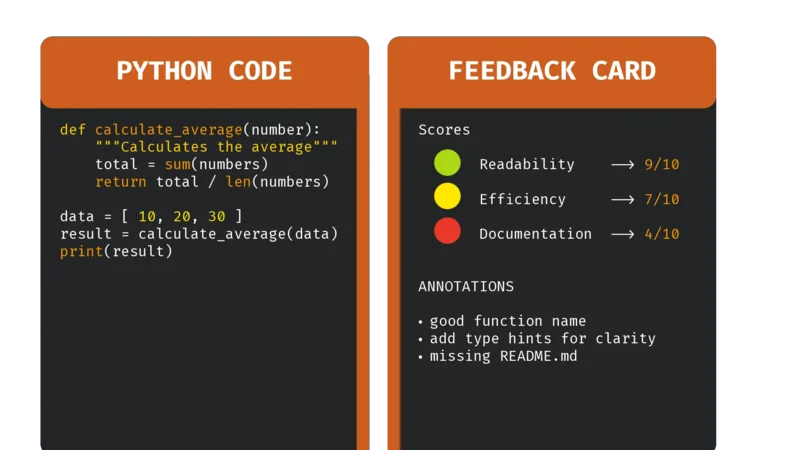
This comparison weighs five dimensions: Python support depth, LMS integration, feedback quality, scalability, and pricing transparency. Tools like CodeGrader are designed around feedback that teaches, not just scores. Others prioritize infrastructure or integration. The right choice depends on your context.
The 5 Best Python Code Graders for Educators in 2026
These five tools span the current spectrum — from open-source frameworks to full LMS-integrated platforms — each with a distinct philosophy about what grading Python means.
Gradescope — Best for Large University Courses
Best for: Professors managing 100+ student cohorts needing plagiarism detection bundled with auto-grading
Gradescope runs Python autograding through Docker using unit-test decorators like @weight and @visibility. Instructors define weighted test cases with hidden edge cases — partial credit gets assigned based on which tests pass. Answer clustering (powered by Turnitin’s AI) groups incorrect solutions so instructors review patterns rather than 120 individual submissions.
Canvas, Moodle, and Turnitin integrations make Gradescope a natural fit for universities already in those ecosystems. The Docker auto-grader supports custom libraries, so NumPy or Pandas assignments don’t require workarounds.
Honest caveat: Pricing is institutional and opaque; independent educators and adjuncts without departmental budgets will find Gradescope effectively inaccessible
CodeGrade — Best for LMS-Integrated Rubric Grading
Best for: Instructors inside an LMS (Canvas, Moodle) who want a code grader Python educators can deploy without switching platforms
CodeGrade runs Pytest + Semgrep + I/O testing in a single pipeline. A 2025 update added Friendly-Traceback, rendering Python errors in human-readable, multilingual format. Inline comments and peer review workflows set it apart from pure pass/fail systems. Jupyter Notebook support launched August 2025.
Pricing: $39/student/course** (Core) or **$54 with AI Assistant. That transparency is unusual in ed-tech and simplifies departmental budgeting.
Honest caveat: Public reviews on G2 and Capterra remain limited. Setup complexity for custom test configurations can frustrate instructors without testing experience.
Codio — Best for Hands-On Bootcamp and Workforce Training
Best for: Bootcamps and workforce trainers needing a complete environment — IDE, content, and grading — in one platform.